Descuento:
-5%Antes:
Despues:
52,36 ۥ Part One: Our Theoretical Journey
1: Positioning for the Journey
2: On Being and Becoming a Scholar
3: Theory: Metaphors, Symbols, Definitions
• Part Two: Our Theoretical Heritage
4: From Can’t to Kant: Barriers and Forces Toward Theoretical Thinking
5: On the Way to Theoretical Nursing: Stages and Milestones
• Part Three: Our Discipline and Its Structure
6: The Discipline of Nursing: Perspective and Domain
7: Sources, Resources, and Paradoxes for Theory
8: Our Syntax: An Epistemological Analysis
• Part Four: Reviewing and Evaluating: Pioneering Theories
9: Nursing Theories Through Mirrors, Microscopes, or Telescopes
10: A Model for Evaluation of Theories: Description, Analysis, Critique, Testing, and Support
11: On Needs and Self-Care
12: On Interactions
13: On Outcomes
• Part Five: On Developing Theories of Different Levels
14: Developing Concepts
15: Developing Theories
16: Developing Middle-Range Theories
17: Developing Situation-Specific Theories
• Part Six: Our Theoretical Future
18. Measuring Progress in a Discipline
19: Fifth-Generation Theorists: Passion for Advancing Theory
• Part Seven: Our Historical and Current Literature
20: Historical Writings in Theory
21: Historical and Current Theory Bibliography
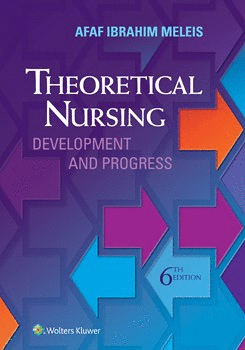
Inspire your students to be theoretical thinkers, innovative advocates, and agents for change.
Focused on cultivating the next generation of scholars, this highly respected classic demystifies theory, charts strategies to use in developing and advancing theory, and provides tools and best practices in evaluating progress in the discipline. Based on the feedback of nursing students, this edition was updated to be more accessible without losing the necessary rigor to foster critical thinking. Meleis provides a developmental and historical review of theoretical nursing and helps readers develop analytic skills and integrate knowledge into a coherent whole. By embarking on the journey of nursing theory, practicing nurses will find ways to improve everyday practice, as well as develop theories that capture their expertise.
Highlights of the Sixth Edition
• Paradigms that influenced nursing thought, such as feminism and post-colonialism
• Nursing Theories, including need, interaction, and outcome theories
• Social and health care transitions and their influence on advancing nursing knowledge
• The most updated global definitions of the discipline of nursing and the future of nursing
• Critical discussions on how different classifications of theories may lead to productive explorations and explanations of the process of clinical judgment and decision making
Key Features
• New online journal articles and case studies give students an opportunity to apply theory to practice.
• Chapter-ending Reflective Questions expand students’ understanding of theory and its impact on nursing today.
• Separate chapters covering Middle Range Theory and Situation-Specific Theory. This text is complemented by and frequently used with Peterson & Bredow’s Middle Range Theories: Application to Nursing Research and Practice.
• A new two-column design that enhances readability.
Author
Afaf I Meleis RN, PhD, FAAN. Dean, School of Nursing, University of Pennsylvania, Philadelphia, PA
 -5%
-5%
 -5%
-5%
 -5%
-5%
 -5%
-5%
 -5%
-5%
 -5%
-5%
 -5%
-5%
 -5%
-5%
 -5%
-5%
 -5%
-5%