Descuento:
-5%Antes:
Despues:
276,63 €- Discusses all aspects of radionuclide therapy, including basic principles, newly available treatments, regulatory requirements, and future trends
- Provides the knowledge required to administer radionuclide therapy safely and effectively in the individual patient
- Explains the role of the therapeutic nuclear physician in effectively coordinating a diverse multidisciplinary team
- Written by leading experts
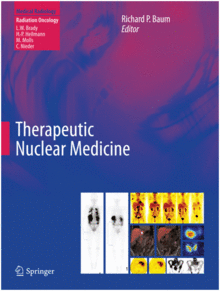
The recent revolution in molecular biology offers exciting new opportunities for targeted radionuclide therapy. The selective irradiation of tumor cells through molecular biological mechanisms is now permitting the radiopharmaceutical control of tumors that are unresectable and unresponsive to either chemotherapy or conventional radiotherapy.
In this up-to-date, comprehensive book, world-renowned experts discuss the basic principles of radionuclide therapy, explore in detail the available treatments, explain the regulatory requirements, and examine likely future developments. The full range of clinical applications is considered, including thyroid cancer, hematological malignancies, brain tumors, liver cancer, bone and joint disease, and neuroendocrine tumors. The combination of theoretical background and practical information will provide the reader with all the knowledge required to administer radionuclide therapy safely and effectively in the individual patient. Careful attention is also paid to the important role of the therapeutic nuclear physician in delivering the effective coordination of a diverse multidisciplinary team that is essential to the safe provision of treatment.
Written for » Professional/practitioner
Keywords » internal dosimetry - peptide receptor radionuclide therapy - radioimmuno therapy - radionuclide therapy
Related subjects » Internal Medicine - Nuclear Medicine - Oncology & Hematology - Radiology
Table of contents (74 chapters)
1.A Historical Perspective on the Use of Radionuclides for Therapy
2.Therapeutic Radionuclides: Production, Physical Characteristics, and Applications
3.Rhenium-188 Generator-Based Radiopharmaceuticals for Therapy
4.Generator-Based Radiopharmaceuticals for PET Dosimetry Before, During, and After Endoradiotherapy
5.Cyclotron-Based Radiopharmaceuticals for Nuclear Medicine Therapy
6.Peptides for Nuclear Medicine Therapy: Chemical Properties and Production
7.Antibodies for Nuclear Medicine Therapy
8.Selective High Affinity Ligands: A New Class of Targeting Agents for Cancer Imaging and Therapy
9.Inorganic Radionuclides for Nuclear Medicine Therapy
10.Pharma Considerations for Timely Development of Therapeutic Radiopharmaceuticals
11.Economic and Industrial Considerations for Marketing of Therapeutic Radiopharmaceuticals
12.Radioimmunotherapy of Brain Tumors
13.Radiopeptide Therapy of Brain Tumors
14.Intracavitary Use of Radionuclides and Treatment of Meningiomas
15.Radio-Tympano-Sinu-Orthesis as a Treatment Option in Chronic Otitis Media and Paranasal Mucositis
16.Sodium Iodide Symporter in Thyroid Carcinoma
17.Gene Expression Analysis by DNA Microarray in Papillary and Follicular Differentiated Thyroid Cancer
18.Ablation Therapy with Radioiodine in Adults and Children with Differentiated Thyroid Cancer
19.Redifferentiation Therapy in Thyroid Cancer
20.Maximal Safe Dose Method of I-131 in the Management of Recurrent/Metastatic Differentiated Thyroid Carcinoma
21.Therapeutic Strategy of Papillary Microcarcinoma of the Thyroid Gland: A Nuclear Medicine Perspective
22.UICC Classifications 1997, 2002 and 2009: What is the Impact on Thyroid Cancer Mangement?
23.Radioiodine Remnant Ablation: A Critical Review
24.Follow-up of Thyroid Cancer Patients and Treatment of Distant Metastases
25.Medullary Thyroid Carcinoma
26.Treatment of Progressive Dedifferentiated and Medullary Thyroid Cancer with Radiolabeled Somatostatin Analogs
27.Radioiodine Therapy of Hyperthyroidism (Toxic Goiter, Hyperfunctioning Nodule) and Non-Toxic Goiter: Procedures and Guidelines
28.Radioiodine Therapy of Hyperthyroidism in Graves’ Disease
29.Radioembolization: Concepts and Procedures
30.Radioembolization: Clinical Results Hepatocellular Carcinoma
31.Radioembolization (Yttrium-90 Microspheres) for Metastatic Hepatic Malignancies
32.Rhenium-188 Lipiodol for the Treatment of Hepatocellular Carcinoma (HCC)
33.New Approaches: Combined Local and Multimodal Strategies in the Treatment of Complex Neuroendocrine Liver Metastases
34.Radiolabelled Bisphosphonates for Bone Pain Palliation
35.Radionuclide Therapy of Bone Metastases Using Rhenium-188 Hydroxyethylidene Diphosphonate
36.Treatment of Osteoblastic Skeletal Metastases by the Alpha-Emitting Bone-Seeker Radium-223
37.Radionuclide Therapy of Inflammatory Joint Diseases (Radiation Synovectomy, Radiosynoviorthesis)
38.Radionuclide Therapy for Bleeding Joints in Hemophilia
39.Non-Hodgkin Lymphoma: Radioimmunotherapy Using Iodine-131 Labeled Murine Anti-CD20 Antibodies
40.Treatment of Lymphoma with
41.Non-Hodgkin’s Lymphoma High Dose Therapy
42.Yttrium-90 Labelled Anti-CD20 Radioimmunotherapy with Stem Cells Support
43.Fractionated Radioimmunotherapy of Non-Hodgkin Lymphoma with 90-Y-Labeled Anti-CD22 Antibody, Epratuzumab Tetraxetan
44.Targeted Alpha Particle Therapy of Peritoneal Carcinomas
45.I-131 Meta Iodobenzylguanidine Therapy
46.Peptide Receptor Radionuclide Therapy of Neuroendocrine Tumors Expressing Somatostatin Receptors
47.Radioimmunotherapy of Tumors: Pretargeting with Bispecific Antibodies
48.Targeted Radionuclide Therapy of Prostate Cancer
49.Radioimmunotherapy of Neuroblastoma
50.Radioimmunotherapy in Metastatic Colorectal Cancer
51.Radioimmunotherapy of Renal Cancer
52.Myeloablative Radioimmunotherapy in Conditioning of Acute Leukemia, MDS, and Multiple Myeloma Prior to Hematological Stem Cell Transplantation
53.Endovascular Brachytherapy to Prevent Restenosis After Percutaneous Coronary Intervention
54.Locoregional Radionuclide Therapy of Primary and Metastatic Cancers
55.Radionuclide Therapy for Skin Malignancies
56.Epidermal Radionuclide Therapy: Dermatological High-Dose-Rate Brachytherapy for the Treatment of Basal and Squamous Cell Carcinoma
57.Patient-Specific Dosimetry, Radiobiology, and the Previously-Treated Patient
58.Nuclear Medicine Dose Assessment
59.Monte Carlo Methods in Nuclear Medicine
60.Dosimetry for Peptide Receptor Radionuclide Therapy
61.Comparison Between
62.Hormesis by Low Dose Radiation Effects: Low-Dose Cancer Risk Modeling Must Recognize Up-Regulation of Protection
63.Animal Models for Developing Radiopharmaceuticals for Therapy
64.Dosimetry in Accidental Radiation Exposure
65.Potential Impact of Radiation Biology in Radiation Protection in Nuclear Medicine and Corresponding Regulatory Issues
66.Radiation Protection of Staff and Public
67.Effects of Music on the Psyche of Neuroendocrine Tumour Patients Undergoing Peptide Receptor Radionuclide Therapy
68.The Use of Dosimetry in the Planning of Patient Therapy
69.PET for Radiotherapy Planning
70.Hypoxia Imaging for Radiation Therapy Planning
71.Chemotherapy Combined with Radionuclide Therapy
72.Role of Surgery in a Multidisciplinary Approach
73.PET for Measuring Therapy Response After Radionuclide Therapy
74.Developing Probes for Molecular Imaging
 -5%
-5%
 -5%
-5%
 -5%
-5%
 -5%
-5%
 -5%
-5%
 -5%
-5%
 -5%
-5%
 -5%
-5%
 -5%
-5%
 -5%
-5%