Descuento:
-5%Antes:
Despues:
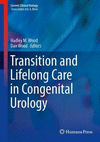
118,55 €Transitional Urology is designed to fill a critical gap that exists in the published literature by comprehensively addressing the urological challenges facing adolescents and adults with complex congenital anomalies of the genitourinary system. It provides a valuable resource to pediatricians and pediatric urologists facing urological management issues beyond their expertise in their aging patients as well astechnical guidance to adult urologists who may have had little or no experience caring for patients with a congenital condition. This work will service as a field guide to congenitalism, providing a “how to” approach to guide the urologist using real clinical examples for the most common and challenging urological problems encountered. It also provides a framework for the transition process from pediatric to adult-centered care, with a special emphasis on the multidisciplinary nature needed to provide patient-centered care. Specific conditions that require special consideration, including myelomeningocele, exstrophy, posterior urethral valves, and hypospadias are highlighted. Topics considered common in the general urology practice- like infertility and sexual dysfunction areaddressed within the context of patients with neurological or anatomical complexity. In addition, this text reviews urological complaints for which basic clinical algorithms are well-established within the context of a congenitally-abnormal bladder.Chapters discuss how and when special testing like video urodynamnics and positional fluoroscopy may be warranted to provide critical diagnostic guidance. The text also review how typical age-related urological phenomena, like elevated PSA, hypogonadism, and BPH, may present in this subset of patients and how treatment of these conditions may be different than the general population.?
Authors
Hadley M. Wood, MD, FACS.
Assistant Professor of Surgery. Center for Genitourinary Reconstruction. Glickman Urological and Kidney Institute. Cleveland, OH.
Dan Wood, PhD FRCS Urol.
University College London Hospitals. Adolescent and Reconstructive Urology. London, UK.
Table of contents (17 chapters)
1.The Transition Process: Initial Assessment and Development of a Treatment Plan
2.Approach to the Myelodysplasia Patient
3.Approach to the Exstrophy Patient
4.Approach to the Adult Hypospadias Patient
5.Sexual Function and Pregnancy in the Female Myelodysplasia Patient
6.Revision Genitoplasty, Sexual Function, Fertility, and Pelvic Organ Prolapse in Exstrophy and the Management of Pregnancy
7.Issues in the Long-Term Management of Adolescents and Adults with DSD: Management of Gonads, Genital Reconstruction, and Late Presentation of the Undiagnosed DSD
8.The Adult Hypospadias Patient: Technical Challenges in Adulthood
9.Urinary Tract Infections in the Reconstructed Bladder: Evaluation and Treatment Options
10.Troubleshooting Continent Catheterizable Channels
11.Augmentation Cystoplasty: Risks for Malignancy and Suggestions for Follow-Up Evaluations
12.BPH and Pelvic Organ Prolapse in Patients with Neurogenic Bladder
13.Posterior Urethral Valves in Adolescents: Clinical Problems, Management, and Follow-Up
14.Renal Transplantation in Patients with Lower Urinary Tract Dysfunction
15.Management of Calculi in Patients with Congenital Neuropathic Bladder
16.Vesicoureteral Reflux and the Adult
17.Adult Survivors of Pediatric Genitourinary Tumors
 -5%
-5%
 -5%
-5%
 -5%
-5%
 -5%
-5%
 -5%
-5%
 -5%
-5%
 -5%
-5%
 -5%
-5%
 -5%
-5%
 -5%
-5%