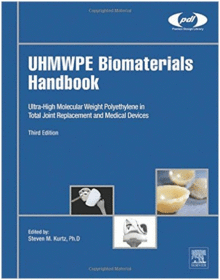
Descuento:
-5%Antes:
Despues:
141,28 €1: A Primer on UHMWPE
Abstract
1.1. Introduction
1.2. What is a Polymer?
1.3. What is Polyethylene?
1.4. Crystallinity
1.5. Thermal Transitions
1.6. Overview of the Handbook
2: From Ethylene Gas to UHMWPE Component: The Process of Producing Orthopedic Implants
Abstract
2.1. Introduction
2.2. Polymerization: from Ethylene Gas to UHMWPE Powder
2.3. Conversion: from UHMWPE Powder to Consolidated Form
2.4. Machining: from Consolidated Form to Implant
2.5. Conclusions
3: Packaging and Sterilization of UHMWPE
Abstract
3.1. Introduction
3.2. Gamma Sterilization in Air
3.3. Gamma Sterilization in Oxygen Barrier Packaging
3.4. Ethylene Oxide Gas Sterilization
3.5. Gas Plasma Sterilization
3.6. The Torino Survey of Contemporary Orthopedic Packaging
3.7. Shelf-Life of UHMWPE Components for Orthopedic Implants
3.8. Overview of Current Trends
Acknowledgments
4: The Origins of UHMWPE in Total Hip Arthroplasty
Abstract
4.1. Introduction and Timeline
4.2. The Origins of a Gold Standard (1958-1982)
4.3. Charnley’s First Hip Arthroplasty Design with PTFE (1958)
4.4. Implant Fixation with Pink Dental Acrylic Cement (1958-66)
4.5. Interim Hip Arthroplasty Designs with PTFE (1958-1960)
4.6. Final Hip Arthroplasty Design with PTFE (1960-1962)
4.7. Implant Fabrication at Wrightington
4.8. The First Wear Tester
4.9. Searching to Replace PTFE
4.10. UHMWPE Arrives at Wrightington
4.11. Implant Sterilization Procedures at Wrightington
4.12. Overview
Acknowledgments
5: The Clinical Performance of Historical and Conventional UHMWPE in Hip Replacements
Abstract
5.1. Introduction
5.2. Joint Replacements do not Last Forever
5.3. Range of Clinical Wear Performance in Cemented Acetabular Components
5.4. Wear Versus Wear Rate of Hip Replacements
5.5. Comparison of Wear Rates between Different Clinical Studies
5.6. Comparison of Wear Rates in Clinical and Retrieval Studies
5.7. Current Methods for Measuring Clinical Wear in THA
5.8. Range of Clinical Wear Performance in Modular Acetabular Components
5.9. Conclusions
Acknowledgments
6: The Clinical Performance of Highly Cross-linked UHMWPE in Hip Replacements
Abstract
6.1. Introduction
6.2. What are First- and Second-Generation HXLPEs?
6.3. Clinical Performance of First-Generation HXLPEs in THA
6.4. Clinical Performance of Second-Generation HXLPEs in THA
6.5. Summary
Acknowledgments
7: Contemporary Total Hip Arthroplasty: Alternative Bearings
Abstract
7.1. Introduction
7.2. Metal-on-Metal (MOM) Alternative Hip Bearings
7.3. Ceramics in Hip Arthroplasty
7.4. Noise and Squeaking from Hard-on-Hard Bearings
7.5. Polyether Ether Ketone (PEEK)
7.6. Polycarbonate Urethane (PCU)
7.7. Summary
8: The Origins and Adaptations of UHMWPE for Knee Replacements
Abstract
8.1. Introduction
8.2. Frank Gunston and the Wrightington Connection to TKA
8.3. Polycentric Knee Arthroplasty
8.4. Unicondylar Polycentric Knee Arthroplasty
8.5. Bicondylar Total Knee Arthroplasty
8.6. Patellofemoral Arthroplasty
8.7. UHMWPE with Metal Backing
8.8. Conclusions
Acknowledgments
9: The Clinical Performance of UHMWPE in Knee Replacements
Abstract
9.1. Introduction
9.2. Biomechanics of Total Knee Arthroplasty
9.3. Clinical Performance of UHMWPE in Knee Arthroplasty
9.4. Osteolysis and Wear in TKA
9.5. Summary
Acknowledgments
10: Contemporary Total Knee Arthroplasty: Alternative Bearings
Abstract
10.1. Introduction
10.2. HXLPE in TKA
10.3. Ceramic Bearings in TKA
10.4. Summary
11: The Clinical Performance of UHMWPE in Shoulder Replacements
Abstract
11.1. Introduction
11.2. The Shoulder Joint
11.3. Shoulder Replacement
11.4. Contemporary Total Shoulder Replacements
11.5. Clinical Performance of Total Shoulder Arthroplasty
11.6. Controversies in Shoulder Replacement
11.7. Future Directions in Total Shoulder Arthroplasty
11.8. Conclusions
Acknowledgments
12: The Clinical Performance of UHMWPE in Elbow Replacements
Abstract
12.1. Introduction
12.2. Anatomy of the Elbow
12.3. Elbow Biomechanics
12.4. Implant Design
12.5. Osteolysis and Wear
12.6. Conclusions
Acknowledgments
13: Applications of UHMWPE in Total Ankle Replacements
Abstract
13.1. Introduction
13.2. Anatomy
13.3. Ankle Biomechanics
13.4. Total Ankle Replacement Design
13.5. UHMWPE Loading and Wear in Total Ankle Replacements
13.6. Complications and Retrieval Analysis
13.7. Conclusions
Acknowledgments
14: The Clinical Performance of UHMWPE in the Spine
Abstract
14.1. Introduction
14.2. The CHARITÉ Artificial Disc
14.3. Lumbar Disc Arthroplasty
14.4. Cervical Disc Arthroplasty
14.5. Wear and In Vivo Degradation of UHMWPE in the Spine
14.6. Alternatives to UHMWPE in Disc Replacement
14.7. Many Unanswered Questions Remain
Acknowledgments
15: Highly Cross-Linked and Melted UHMWPE
Abstract
15.1. Introduction
15.2. Radiation Cross-Linking
15.3. Irradiation and Melting
15.4. Effect of Radiation Dose, Melting, and Irradiation Temperature, on UHMWPE Properties
15.5. Effect of Cross-Linking on Fatigue Resistance
15.6. Optimum Radiation Dose
15.7. Hip Simulator Data
15.8. Knee Simulator Data
15.9. Clinical Follow-Up Studies
15.10. In Vivo Changes - Explants
15.11. Conclusions
16: Highly Cross-Linked and Annealed UHMWPE
Abstract
16.1. Introduction
16.2. Development of Duration Stabilized UHMWPE
16.3. Crossfire
16.4. X3 - Sequentially Irradiated and Annealed UHMWPE
16.5. Conclusions
Acknowledgments
17: Vitamin E-Blended UHMWPE Biomaterials
Abstract
17.1. Introduction
17.2. Vitamin E as an Antioxidant for Polyolefins
17.3. Vitamin E Blends in Food Packaging
17.4. Vitamin E Studies from Japan
17.5. VITASUL and Vitamin E Studies from Austria
17.6. Vitamin E Studies from Italy
17.7. Vitamin E Blends and Thresholds for Oxidative Stability
17.8. Vitamin E Blends and Mechanical Behavior
17.9. Vitamin E Blends and Cross-Linking Efficiency
17.10. Warm Irradiation and Postirradiation Treatment of Vitamin E Blends
17.11. Conclusions
Acknowledgment
18: Highly Cross-Linked UHMWPE Doped with Vitamin E
Abstract
18.1. Introduction
18.2. Function of Vitamin E
18.3. Diffusion of Vitamin E in Cross-Linked UHMWPE
18.4. Wear
18.5. Mechanical and Fatigue Properties
18.6. Oxidative Stability
18.7. Biocompatibility
18.8. Conclusions and Future Prospects
Acknowledgments
19: Alternate Antioxidants for Orthopedic Devices
Abstract
19.1. Introduction
19.2. Historical Perspective
19.3. Commercial Listing and Trade Names
19.4. Mechanistic Studies on Radical Stabilization
19.5. Oxidative Stability Studies
19.6. Material Property Characterization
19.7. Biocompatibility and Biological Response
19.8. Ionizing Radiation Effects on Antioxidants
19.9. Antioxidants in Food and Healthcare
19.10. Antioxidants in Orthopedic Implants
19.11. Conclusions
Acknowledgment
20: Phospholipid Polymer Grafted Highly Cross-Linked UHMWPE
Abstract
20.1. Articular Cartilage
20.2. Surface Modification with Hydrophilic Polymer
20.3. PMPC-Grafted Polyethylene for Artificial Hip Joints
20.4. Future Perspectives
Acknowledgments
21: UHMWPE Matrix Composites
Abstract
21.1. Introduction
21.2. CFR-UHMWPE Composite: Poly II
21.3. CNTs-UHMWPE Composites
21.4. Graphene-UHMWPE Composites
21.5. Other UHMWPE Matrix Composites For Orthopedic Bearings
21.6. Polyethylene-HA Composites
21.7. Summary
Acknowledgments
22: UHMWPE Homocomposites and Fibers
Abstract
22.1. Introduction
22.2. UHMWPE Homocomposites
22.3. UHMWPE Fibers
Acknowledgments
23: UHMWPE-Hyaluronan Microcomposite Biomaterials
Abstract
23.1. Introduction
23.2. Surface Modification of UHMWPE
23.3. Polyurethanes and Hydrogels
23.4. Hyaluronan (HA)
23.5. Synthesis and Processing of UHMWPE-HA Microcomposites
23.6. UHMWPE-HA
23.7. Cross-Linked UHMWPE-HA
23.8. Cross-Linked Compatibilized UHMWPE-HA
23.9. Chemical and Physical Characterization of UHMWPE-HA Biomaterials
23.10. UHMWPE-HA Composition
23.11. UHMWPE-HA Hydrophilicity
23.12. UHMWPE-HA Biostability
23.13. UHMWPE Crystallinity in UHMWPE-HA
23.14. Mechanical and Tribological Characterization of UHMWPE-HA Biomaterials
23.15. Sterilization of UHMWPE-HA Biomaterials
23.16. Biocompatibility of UHMWPE-HA Biomaterials
23.17. Commercialization of UHMWPE-HA Biomaterials
23.18. Conclusions
Acknowledgments
24: High Pressure Crystallized UHMWPEs
Abstract
24.1. Introduction
24.2. Extended Chain Crystallization
24.3. Hylamer
24.4. Cross-Linking Followed by High Pressure Crystallization
24.5. High Pressure Crystallization Followed by Cross-Linking
24.6. Summary
Acknowledgments
25: Compendium of HXLPEs
Abstract
25.1. Introduction
25.2. AltrX™
25.3. AOX™
25.4. ArCom XL Polyethylene
25.5. Crossfire
25.6. Durasul®
25.7. E1 Polyethylene
25.8. Longevity
25.9. Marathon
25.10. Prolong
25.11. Vivacit-E
25.12. X3
25.13. XLK
25.14. XLPE
Acknowledgments
26: Mechanisms of Cross-Linking, Oxidative Degradation, and Stabilization of UHMWPE
Abstract
26.1. Introduction
26.2. Mechanism of Macroradicals Formation During Irradiation
26.3. Mechanism of Cross-Linking
26.4. UHMWPE Oxidation
26.5. Critical Products of Oxidation Process - Macroradicals
26.6. Critical Products of the Oxidation Process: Oxidized Products
26.7. Stabilization UHMWPE
26.8. Consideration on Industrial Cross-Linking and Sterilization of Prosthetic Components
26.9. In vivo Absorption of Lipids
26.10. Chemical Properties of Wear Debris
Acknowledgments
27: In Vivo Oxidation of UHMWPE
Abstract
27.1. Introduction
27.2. Perspective of In Vivo Oxidation in the 1980s to the Present
27.3. Experimental Techniques for Studying In Vivo Oxidation
27.4. Clinical Significance of In Vivo Oxidation
27.5. Laboratory Simulation of In Vivo Oxidation
27.6. Summary and Conclusions
Acknowledgments
28: Pathophysiologic Reactions to UHMWPE Wear Particles
Abstract
28.1. Introduction
28.2. Rationale for Evaluating Tissue Responses
28.3. Immune System
28.4. Immunologic Responses to Joint Replacement UHMWPE Wear Debris
28.5. In Vitro and In Vivo Models Used to Study the Immune Response to UHMWPE Wear Debris
28.6. Inflammatory and Noninflammatory Histopathologic Changes in Periprosthetic Tissues that Promote Heterotopic Ossification and/or Osteolysis
28.7. Current Considerations Based on More Recent Findings and Approaches to Tissue Analysis
28.8. Exacerbation of the Immune Response to Wear Debris as a Result of Subclinical Infection
28.9. HXLPE and Histopathophysiologic Changes in Periprosthetic Hip Tissues from Implant Retrievals
28.10. Conclusions
Acknowledgments
29: Characterization of Physical, Chemical, and Mechanical Properties of UHMWPE
Abstract
29.1. Introduction
29.2. What does the FDA Require?
29.3. Physical Property Characterization
29.4. Chemical Property Characterization
29.6. Antioxidant Measurements
29.7. Accelerated Aging
29.8. Wear Testing
29.9. Conclusions
30: Wear Assessment of UHMWPE with Pin-on-Disc Testing
Abstract
30.1. Introduction
30.2. Considerations and Pitfalls for POD Testing of UHMWPE
30.3. Development of POD Testing
30.4. International Standardization of POD Testing (ASTM F732)
31: Tribology of UHMWPE in the Hip
Abstract
31.1. Introduction
31.2. Tribology
31.3. Hip Joint Simulators
31.4. Quantification of Wear and Surface Measurements
31.5. International Standards
31.6. Clinical Validation of Hip Simulators
31.7. Summary
32: Tribological Assessment of UHMWPE in the Knee
Abstract
32.1. Introduction
32.2. Testing UHMWPE within Whole TKR Systems
32.3. Considerations and Pitfalls in Knee Wear Testing of UHMWPE
32.4. Concluding Remarks and Future Directions in UHMWPE and TKR Longevity Test Methods
33: Characterization of UHMWPE Wear Particles
Abstract
33.1. Introduction
33.2. Rationale for Wear Particle Isolation
33.3. Delipidization of Samples
33.4. Alkali Digestion of Periprosthetic Tissues and Simulator Lubricants
33.5. Acid Digestion of Periprosthetic Tissues and Simulator Lubricants
33.6. Enzyme Digestion of Periprosthetic Tissues and Simulator Lubricants
33.7. Silicon Wafer Display Protocol
33.8. Centrifugation of Samples
33.9. Filtering to Recover Particles
33.10. Polarised Light Microscopy of Tissue Samples
33.11. Scanning Electron Microscopy Analysis
33.12. Atomic Force Microscopy
33.13. Image Analysis of UHMWPE Wear Particles
33.14. Automated Particle Analysis
33.15. Standards
33.16. Particle Measurements (Size/Shape Descriptors)
33.17. Predicting Functional Biological Activity
33.18. Antioxidant Additives to UHMWPE
33.19. Conclusions
Acknowledgments
34: Clinical Surveillance of UHMWPE Using Radiographic Methods
Abstract
34.1. Introduction
34.2. Early Manual Methods for Radiographic Measurement
34.3. Radiostereometric Analysis
34.4. Non-RSA Methods
34.5. Other Factors to Consider
35: ESR Insights into Macroradicals in UHMWPE
Abstract
35.1. Introduction
35.2. Basic Principle of ESR
35.3. Free Radicals in UHMWPE
35.4. Long-Lived Radicals in UHMWPE
35.5. Intermediate Radicals in UHMWPE
35.6. Vitamin E-Doped UHMWPE
35.7. Application of ESR for Quantitative Measure of Free Radicals in UHMWPE
Acknowledgments
36: Fatigue and Fracture of UHMWPE
Abstract
36.1. Introduction
36.2. Fatigue Resistance
36.3. Fracture Resistance
37: Development and Application of the Notched Tensile Test to UHMWPE
Abstract
37.1. Introduction
37.2. Overview of Notch Behavior
37.3. Part I: Monotonic Tension Studies
37.4. Part II: Notched Fatigue Life Studies
37.5. Conclusions and Future Directions
38: Development and Application of the Small Punch Test to UHMWPE
Abstract
38.1. Introduction
38.2. Overview and Metrics of the Small Punch Test
38.3. Accelerated and Natural Aging of UHMWPE
38.4. In Vivo Changes in Mechanical Behavior of UHMWPE
38.5. Effect of Cross-linking on Mechanical Behavior and Wear
38.6. Shear Punch Testing of UHMWPE
38.7. Fatigue Punch Testing of UHMWPE
38.8. Conclusions
39: Computer Modeling and Simulation of UHMWPE
Abstract
39.1. Introduction
39.2. Overview of Available Modeling and Simulation Approaches
39.3. Characteristic Material Behavior of UHMWPE
39.4. Material models for UHMWPE
39.5. Discussion
Acknowledgments
40: Nano- and Microindentation Testing of UHMWPE
Abstract
40.1. Introduction
40.2. Depth-Sensing Indentation Testing Methods
40.3. Indentation Tests on UHMWPE: Structure-Property Testing
40.4. Nanoscratch Single Asperity Wear Tests and Their Effects on Indentation Behavior
40.5. Conclusions
Acknowledgment
41: MicroCT Analysis of Wear and Damage in UHMWPE
Abstract
41.1. Introduction
41.2. MicroCT Scanning
41.3. Evaluation of Penetration in THA using Geometric Primitives
41.4. Evaluation of Penetration in Nonregularly Shaped Components
41.5. Assessing Subsurface Cracking using microCT
41.6. Using microCT to Visualize Third Body Wear
41.7. Conclusions
Acknowledgments
Subject Index
• The only complete reference for professionals, researchers, and clinicians working with ultra-high molecular weight polyethylene biomaterials technologies for joint replacement and implants
• New edition includes six new chapters on a wide range of topics, including the clinical performance of highly crosslinked polyethylene (HXLPE) in hip and knee replacement, an overview of antioxidant stabilization for UHMWPE, and the medical applications of UHMWPE fibers
• State-of-the-art coverage of the latest UHMWPE technology, orthopedic applications, biomaterial characterization, and engineering aspects from recognized leaders in the field.
Author
Steven M. Kurtz, Ph.D., Director, Implant Research Center and Associate Professor, Drexel University; Research Assistant Professor, Thomas Jefferson University, Philadelphia, PA, USA.
Table Of Contents:
• Dedication
• List of Contributors
• Foreword
• 1: A Primer on UHMWPE
• 2: From Ethylene Gas to UHMWPE Component: The Process of Producing Orthopedic Implants
• 3: Packaging and Sterilization of UHMWPE
• 4: The Origins of UHMWPE in Total Hip Arthroplasty
• 5: The Clinical Performance of Historical and Conventional UHMWPE in Hip Replacements
• 6: The Clinical Performance of Highly Cross-linked UHMWPE in Hip Replacements
• 7: Contemporary Total Hip Arthroplasty: Alternative Bearings
• 8: The Origins and Adaptations of UHMWPE for Knee Replacements
• 9: The Clinical Performance of UHMWPE in Knee Replacements
• 10: Contemporary Total Knee Arthroplasty: Alternative Bearings
• 11: The Clinical Performance of UHMWPE in Shoulder Replacements
• 12: The Clinical Performance of UHMWPE in Elbow Replacements
• 13: Applications of UHMWPE in Total Ankle Replacements
• 14: The Clinical Performance of UHMWPE in the Spine
• 15: Highly Cross-Linked and Melted UHMWPE
• 16: Highly Cross-Linked and Annealed UHMWPE
• 17: Vitamin E-Blended UHMWPE Biomaterials
• 18: Highly Cross-Linked UHMWPE Doped with Vitamin E
• 19: Alternate Antioxidants for Orthopedic Devices
• 20: Phospholipid Polymer Grafted Highly Cross-Linked UHMWPE
• 21: UHMWPE Matrix Composites
• 22: UHMWPE Homocomposites and Fibers
• 23: UHMWPE-Hyaluronan Microcomposite Biomaterials
• 24: High Pressure Crystallized UHMWPEs
• 25: Compendium of HXLPEs
• 26: Mechanisms of Cross-Linking, Oxidative Degradation, and Stabilization of UHMWPE
• 27: In Vivo Oxidation of UHMWPE
• 28: Pathophysiologic Reactions to UHMWPE Wear Particles
• 29: Characterization of Physical, Chemical, and Mechanical Properties of UHMWPE
• 30: Wear Assessment of UHMWPE with Pin-on-Disc Testing
• 31: Tribology of UHMWPE in the Hip
• 32: Tribological Assessment of UHMWPE in the Knee
• 33: Characterization of UHMWPE Wear Particles
• 34: Clinical Surveillance of UHMWPE Using Radiographic Methods
• 35: ESR Insights into Macroradicals in UHMWPE
• 36: Fatigue and Fracture of UHMWPE
• 37: Development and Application of the Notched Tensile Test to UHMWPE
• 38: Development and Application of the Small Punch Test to UHMWPE
• 39: Computer Modeling and Simulation of UHMWPE
• 40: Nano- and Microindentation Testing of UHMWPE
• 41: MicroCT Analysis of Wear and Damage in UHMWPE
• Subject Index
 -5%
-5%
 -5%
-5%
 -5%
-5%
 -5%
-5%
 -5%
-5%
 -5%
-5%
 -5%
-5%
 -5%
-5%
 -5%
-5%
 -5%
-5%